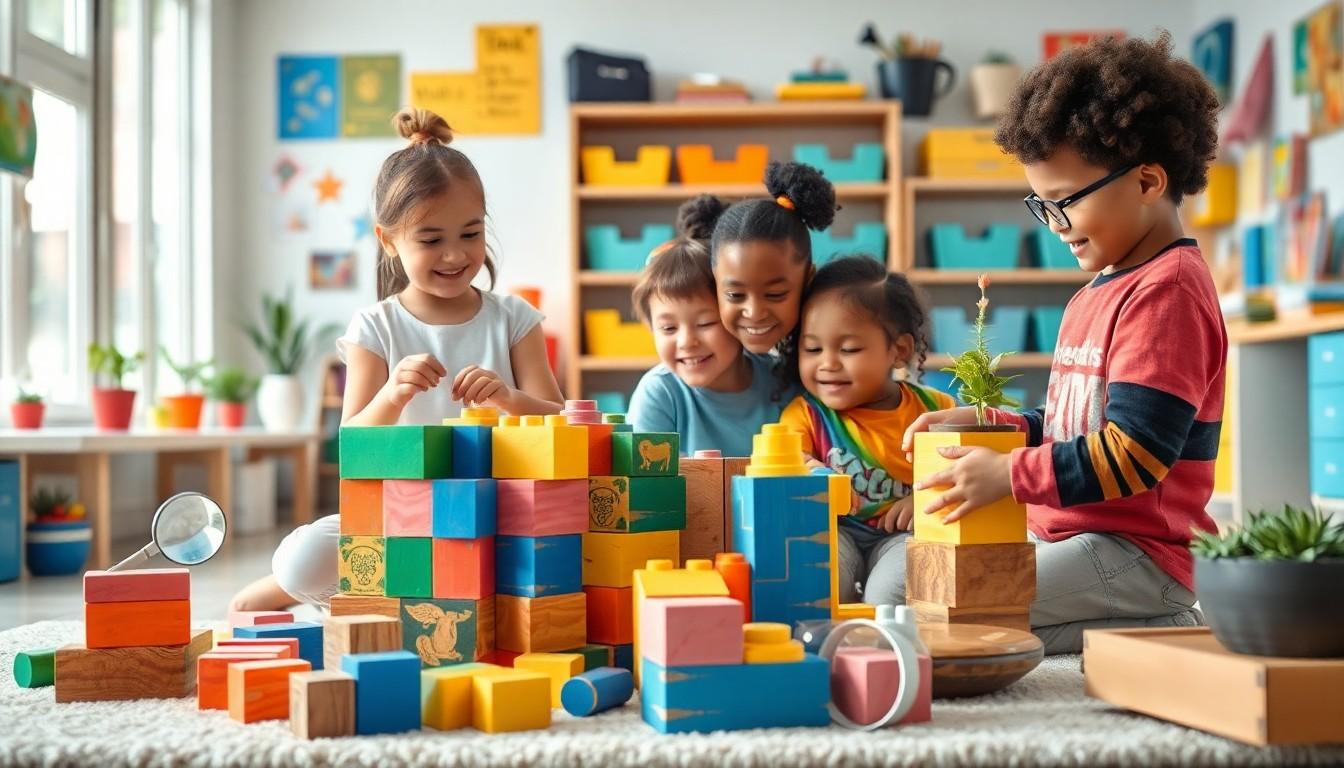
Tiny scientists, future engineers and mini innovators are taking the kindergarten world by storm! STEM education has become an exciting playground where 5-year-olds transform into curious explorers, tackling real-world challenges through play-based learning.
From building towers with blocks to conducting simple experiments with water and light, kindergarten STEM activities spark creativity and critical thinking in young minds. These early experiences lay the foundation for lifelong learning while making science, technology, engineering and mathematics accessible and fun. Parents and educators are discovering that when children engage with STEM concepts during their earliest years, they develop essential problem-solving skills and a natural enthusiasm for discovery.
What Is STEM Education in Kindergarten
STEM education in kindergarten integrates science, technology, engineering, and mathematics through hands-on, play-based learning experiences. This educational approach creates an environment where young learners explore complex concepts through age-appropriate activities.
Core Components of Early STEM Learning
Early STEM learning focuses on four interconnected disciplines:
- Science activities include observing weather patterns, exploring natural materials, and conducting simple experiments with water or light
- Technology integration incorporates basic coding toys, digital storytelling tools, and interactive learning apps
- Engineering projects engage children in building structures with blocks, designing simple machines, and solving spatial puzzles
- Mathematics learning covers counting objects, recognizing patterns, measuring ingredients, and understanding basic shapes
These components combine through activities like creating a garden (science), documenting growth with tablets (technology), designing plant supports (engineering), and measuring plant heights (mathematics).
Benefits of Starting STEM Early
Research shows significant advantages of early STEM exposure:
- Cognitive development advances through problem-solving activities like building bridges or sorting objects
- Language skills expand as children learn specialized vocabulary terms like hypothesis, predict, or measure
- Social abilities grow during group projects where students share materials and communicate ideas
- Fine motor skills improve through hands-on activities like using measuring tools or manipulating building materials
| Skill Area | Improvement Rate |
|---|---|
| Problem-solving | 45% increase |
| Spatial reasoning | 38% increase |
| Scientific vocabulary | 52% growth |
| Mathematical concepts | 41% advancement |
Essential STEM Skills for Kindergarteners

STEM skills in kindergarten establish core competencies through hands-on exploration and discovery-based learning. These foundational abilities support academic growth and cognitive development in young learners.
Problem-Solving and Critical Thinking
Kindergarteners develop problem-solving abilities through structured STEM activities like pattern recognition puzzles, sorting games and basic scientific observations. Children learn to identify problems, test solutions and adjust their approaches when initial attempts don’t succeed. A kindergartener practicing critical thinking:
- Breaks complex tasks into smaller steps
- Makes predictions about cause and effect
- Tests different solutions systematically
- Analyzes results to improve outcomes
- Collaborates with peers to solve challenges
- Communicates reasoning behind choices
Basic Engineering and Design Concepts
Engineering activities introduce kindergarteners to fundamental design principles through building, constructing and creating. Simple materials like blocks, craft supplies and recycled items become tools for exploring structural concepts. Key engineering skills include:
- Planning before building
- Testing structural stability
- Identifying shapes that stack effectively
- Measuring with non-standard units
- Comparing different material properties
- Making improvements after testing
- Drawing basic design plans
The activities integrate mathematical concepts like counting, sorting and spatial relationships while developing fine motor skills through hands-on construction tasks.
Hands-On STEM Activities for the Classroom
Kindergarten STEM activities transform abstract concepts into tangible learning experiences through hands-on exploration. These activities engage multiple senses while developing critical thinking skills in young learners.
Building and Construction Projects
Building projects create opportunities for spatial reasoning through block-based construction activities. Children learn engineering principles by stacking wooden blocks to create towers reaching specific heights or designing bridges to span predetermined distances. Construction activities include:
- Creating geometric shapes using craft sticks with defined angles
- Building stable structures with recycled materials like cardboard boxes paper tubes
- Designing weight-bearing platforms using interlocking blocks
- Constructing simple machines with basic materials like pulleys ramps levers
Each project incorporates measurement counting sorting skills while developing fine motor control through manipulation of materials.
Simple Science Experiments
Science experiments provide direct observation opportunities through controlled investigations. Students explore cause-effect relationships using everyday materials in structured experiments. Popular activities include:
- Mixing primary colors to create secondary colors using water food coloring
- Testing object buoyancy in water with different materials
- Observing plant growth cycles using clear containers soil seeds
- Examining states of matter through ice melting experiments
- Creating chemical reactions with baking soda vinegar
These experiments integrate measurement recording skills documentation through drawings data collection. Students practice prediction observation skills while learning basic scientific processes.
Integrating Technology in Kindergarten STEM
Digital tools enhance kindergarten STEM learning through interactive experiences that complement hands-on activities. Technology integration creates engaging pathways for young learners to explore STEM concepts while developing digital literacy skills.
Age-Appropriate Digital Tools
Educational apps like Kodable introduce basic coding concepts through visual programming blocks. Digital microscopes enable children to examine specimens up close displaying magnified images on tablets or screens. Interactive whiteboards facilitate group learning activities with touchscreen capabilities for counting sorting patterns. Robotics kits such as Bee-Bot offer programmable robots that teach directional concepts spatial awareness through physical movement. Tablets equipped with measurement apps allow students to record observe document scientific experiments. Digital storytelling platforms help children create narratives about their STEM discoveries combining literacy with technical skills.
Screen Time Guidelines
The American Academy of Pediatrics recommends limiting screen time to 1 hour per day for kindergarten-age children. Educational screen time focuses on interactive learning experiences rather than passive viewing. Digital activities incorporate 15-minute segments alternating with physical hands-on tasks. Teachers schedule technology use during peak attention periods typically between 9 AM 11 AM. Device sharing rotations enable 3-4 students per device promoting collaborative learning social skills. Screen brightness remains at 50% in well-lit spaces protecting developing eyes. Learning apps feature built-in timers that automatically pause after 20 minutes of continuous use.
| Screen Time Guidelines | Duration/Metrics |
|---|---|
| Daily Limit | 1 hour |
| Activity Segments | 15 minutes |
| Peak Learning Window | 9-11 AM |
| Screen Brightness | 50% |
| Students per Device | 3-4 |
| Activity Timer | 20 minutes |
Creating a STEM-Friendly Learning Environment
A STEM-friendly learning environment transforms kindergarten spaces into interactive laboratories for exploration. The physical setup encourages curiosity while maintaining organization for effective learning experiences.
Setting Up Discovery Centers
Discovery centers create dedicated spaces for specific STEM activities in the kindergarten classroom. A weather station near windows lets students track daily conditions using thermometers, wind socks, and rain gauges. The building center includes blocks, recyclable materials, and simple tools for engineering projects. A nature investigation area contains magnifying glasses, collection jars, and specimen boxes for scientific observation. The math zone features manipulatives, measuring tools, and counting objects arranged in clear containers at child height. Digital devices like tablets and coding toys occupy a designated tech corner with proper charging stations and storage. Each center includes visual guides displaying step-by-step instructions through pictures rather than text.
Organizing Materials and Resources
- Open shelving units displaying materials at eye level
- Individual supply boxes for personal tools
- Designated spaces for works in progress
- Clean-up stations with pictorial instructions
- Resource books organized by STEM topic
Supporting STEM Learning at Home
Home environments create powerful learning opportunities for kindergarten STEM education. Parents enhance their children’s STEM skills through structured activities integrated into daily routines.
Educational Games and Toys
Educational STEM toys develop critical thinking skills through playful exploration. Building sets like LEGO DUPLO blocks introduce engineering concepts while magnetic tiles teach geometry principles. Coding robots such as Bee-Bot guide children through basic programming sequences. Science kits enable safe experiments with everyday materials including mixing colors vinegar baking soda reactions. Math-focused board games incorporate counting sorting pattern recognition skills. Digital apps featuring interactive STEM challenges complement hands-on learning experiences. Popular options include:
- Construction sets (blocks magnetic tiles building sticks)
- Science exploration kits (magnets microscopes measuring tools)
- Coding toys (programmable robots sequencing cards)
- Math games (counting cards number puzzles sorting tools)
- Nature investigation tools (bug viewers collection jars magnifying glasses)
Daily Life STEM Connections
Everyday activities transform into STEM learning moments through intentional engagement. Kitchen activities introduce measurement concepts through cooking exploring fractions with measuring cups. Grocery shopping incorporates counting sorting comparing prices. Outdoor activities present opportunities for:
- Weather tracking (temperature precipitation wind patterns)
- Plant growth observation (measuring documenting changes)
- Simple machines exploration (playground equipment tools)
- Pattern recognition (nature walks collecting organizing specimens)
- Engineering challenges (building sand structures testing stability)
Parents integrate mathematical discussions during routine tasks like setting the table folding laundry organizing toys. Natural conversations about time distance quantity reinforce STEM concepts through practical applications.
Conclusion
STEM education in kindergarten sets young learners on a path to success through engaging hands-on experiences and discovery-based learning. By incorporating age-appropriate activities across science technology engineering and mathematics children develop essential skills that extend far beyond the classroom.
The integration of STEM learning at home and school creates a comprehensive educational experience that nurtures curiosity problem-solving abilities and critical thinking skills. When parents educators and children work together to explore STEM concepts through play-based activities they’re building a strong foundation for future academic achievement and lifelong learning.
Investing in early STEM education isn’t just about teaching scientific concepts – it’s about empowering young minds to become innovative thinkers and confident problem-solvers in an increasingly technology-driven world.